
With the rise of accessible AI tools, marketers now have the power to scale content creation, analyze data, and engage with audiences in smarter ways than ever before. 61% of marketers say AI is the most important aspect of their data strategy. Yet, 60% of small businesses still waste hours daily on repetitive tasks.
Before I discovered ChatGPT, marketing felt like a full-time job. I was stuck writing posts, brainstorming blog ideas, and juggling content for every platform. Sound familiar?
Now, I generate 30+ posts, 5 blogs, and 10 emails in under 5 hours. All with ChatGPT.
In this guide, I’ll walk you through exact prompts, workflows, and tools I use weekly to automate my marketing in 2026 without hiring a team.
What is ChatGPT?

ChatGPT is like having a 24/7 content assistant who never takes breaks. It’s a generative AI chatbot developed by OpenAI, capable of writing blog posts, drafting email funnels, creating SEO metadata, and building out entire content calendars all with simple prompts.
How Does ChatGPT Work?
At its core, ChatGPT uses a language model (GPT-5 as of now) trained on a massive amount of text data. You interact with it via simple prompts, and it provides intelligent responses based on context, patterns, and probabilities.
The real power comes when you train ChatGPT to understand your tone, brand style, and marketing goals. The better your prompts, the better the output, this is the secret sauce of AI marketing!
Limitations of ChatGPT
Let’s be honest. While ChatGPT is incredibly helpful, it’s not perfect.
- It may generate outdated information (if not connected to live data).
- It lacks emotional intelligence: You need to fine-tune your tone manually.
- It can be generic without clear input, so strong prompts are a must.
- It doesn’t replace strategy. AI is your assistant, not your strategist.
So while you can automate content marketing with ChatGPT, you still need human oversight and creativity.
Does Google Penalize AI-Generated Content?
This is one of the most common questions marketers ask.
No, Google doesn’t penalize content just because it’s AI-generated. What Google cares about is helpful, original, people-first content (E-E-A-T: Experience, Expertise, Authoritativeness, Trustworthiness).
In fact, in their official guidance, Google said:
“Using automation, including AI, to generate content with the primary purpose of manipulating ranking in search results is a violation. But AI-generated content that’s helpful and created for people is not against our guidelines.”
Key Stats:
- 72% of marketers using AI tools rank higher on Google (HubSpot).
- AI-generated content ranks equally with human-written content if it’s edited and optimized (SEMrush).
So, as long as your content is helpful, SEO-optimized, and user-focused, using ChatGPT is absolutely a fair game.
How My Content Creation System Works
Before ChatGPT, I used to spend 4-6 hours a week brainstorming content ideas, writing posts, and scheduling everything manually.
Now? I use ChatGPT to:
- Generate blog topics
- Write social media captions
- Repurpose blogs into tweets, reels, and LinkedIn posts
- Create email marketing copy
- Draft product descriptions
Result: I cut content creation time by 70% and boosted website traffic by 40% in 6 months.
Here’s my weekly workflow:
- Brainstorm content ideas using ChatGPT prompts.
- Generate drafts for each channel.
- Edit for brand tone and SEO.
- Schedule via social tools like Buffer or Notion AI.
6 Ways to Use ChatGPT for Content Marketing
1. Blog Post Generation
I use it to help structure outlines and even first drafts of blogs.
Prompt: “Write a 1000-word SEO blog post on best content marketing tips for small businesses in 2026.”
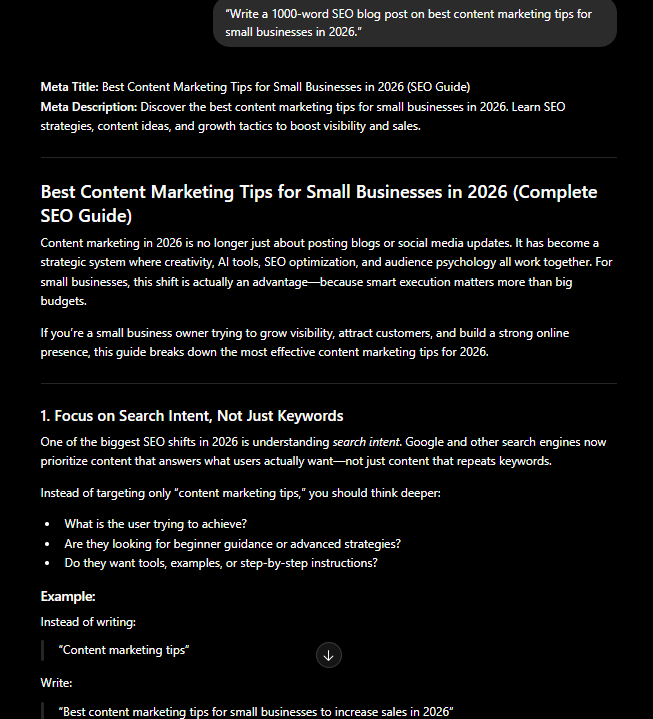
It cut my writing time in half.
2. Social Media Caption Ideas
Whether it’s LinkedIn, Instagram, or X, I use it to draft attention-grabbing captions.
Prompt: “Give me 5 Instagram captions for a new product launch targeting freelancers.”
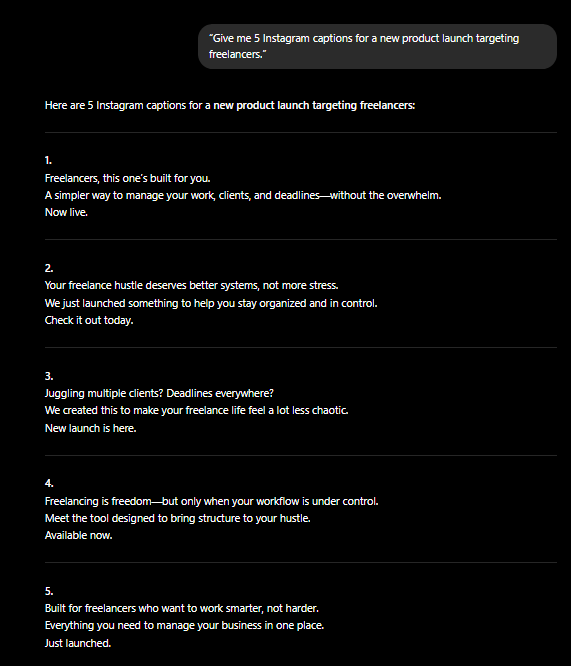
The responses are quick, brandable, and save hours of work.
3. Email Marketing Campaigns
I draft full emails in seconds, from welcome emails to re-engagement flows.
Prompt: “Write an email funnel sequence to promote a free webinar on content marketing for entrepreneurs.”
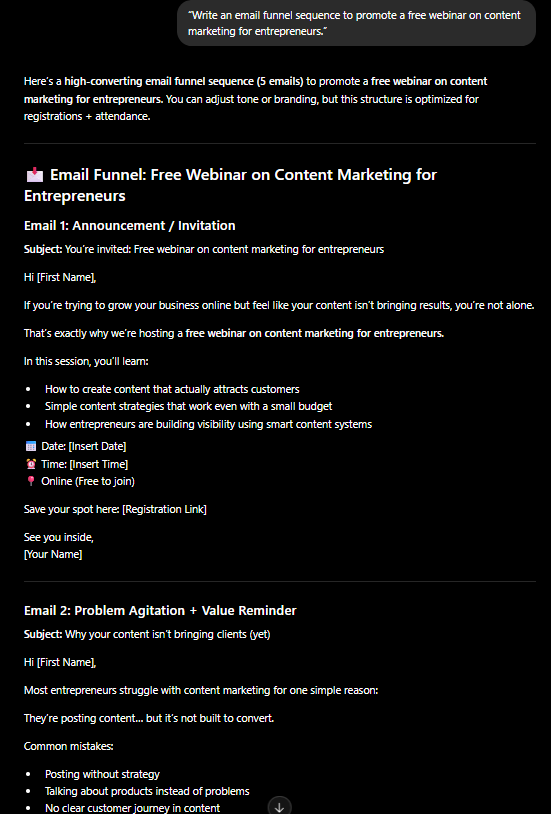
I edit the tone slightly and it’s ready to send.
4. Content Repurposing
Turn one blog post into multiple short-form pieces.
Prompt: “Convert the above blog post into a LinkedIn carousel summary.”
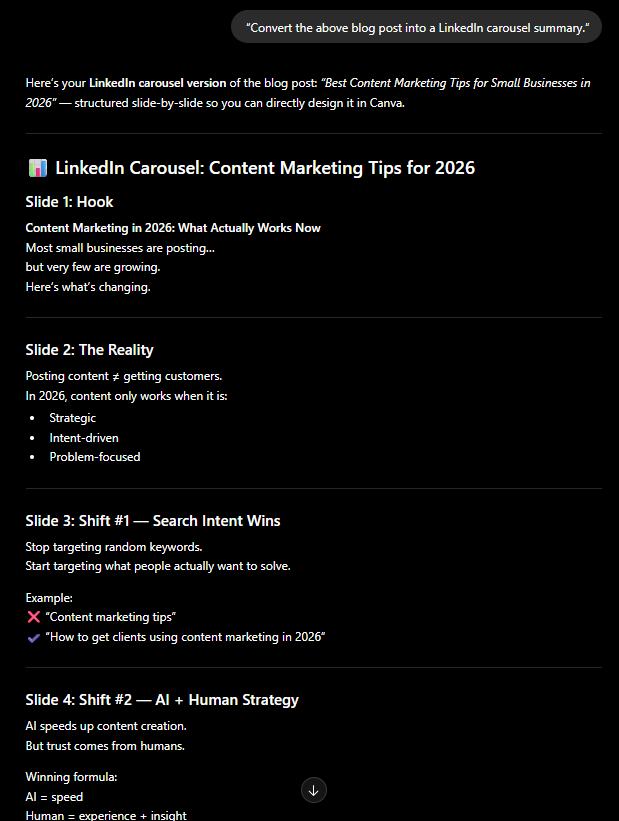
This helps me maximize reach from every piece I create.
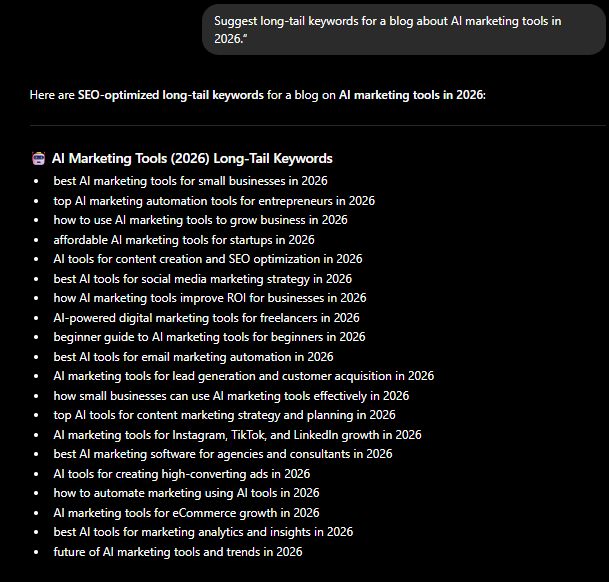
5. Keyword Suggestions
I just asked chatGPT to help me with keyword research.
Prompt: “Suggest long-tail keywords for a blog about AI marketing tools in 2026.”
6. Content Calendars
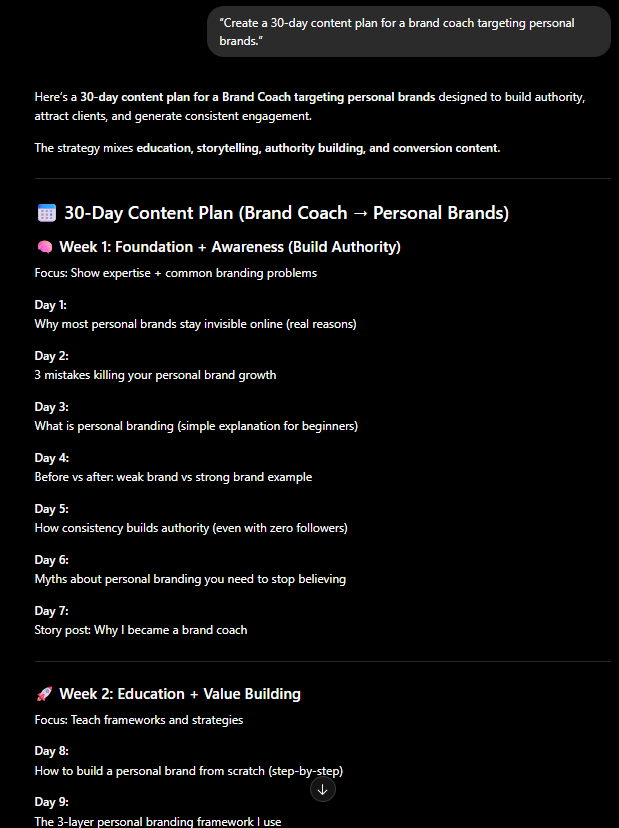
Content Calendars are the most important part of today’s marketing campaigns and I asked chatGPT to help me in generating a content calendar for 30 days.
Prompt: “Create a 30-day content plan for a brand coach targeting personal brands.”
Step-by-Step Guide on How I Used ChatGPT to Automate My Marketing
Step 1: Content Planning
Prompt: “Give me 10 content ideas for social media targeting small business owners.”
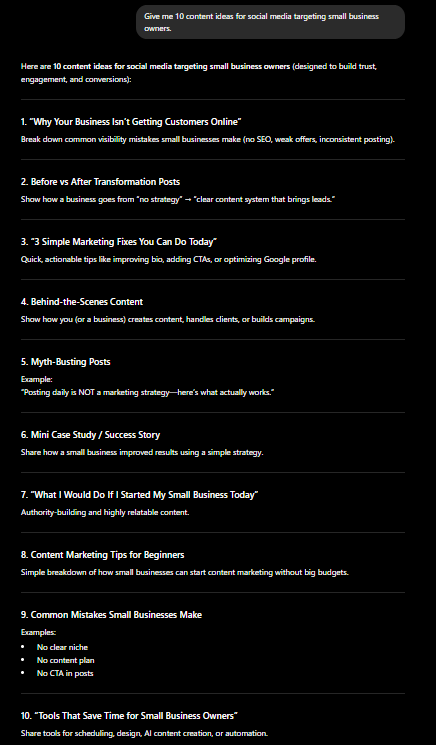
→ ChatGPT gave me a full content bank I could pull from.
Step 2: Writing the Content
Prompt: “Write a 100-word Instagram caption for a post about ‘how to create content faster with AI’.”
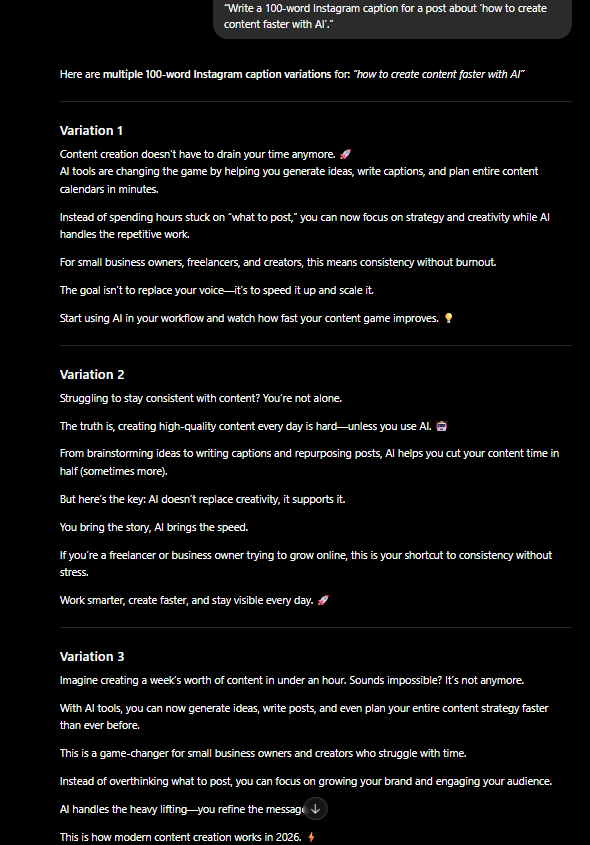
→ I received 3-4 versions instantly, ready to post.
Step 3: SEO Optimization
Prompt: “Write SEO title and meta description for a blog on AI tools for productivity in 2026.”
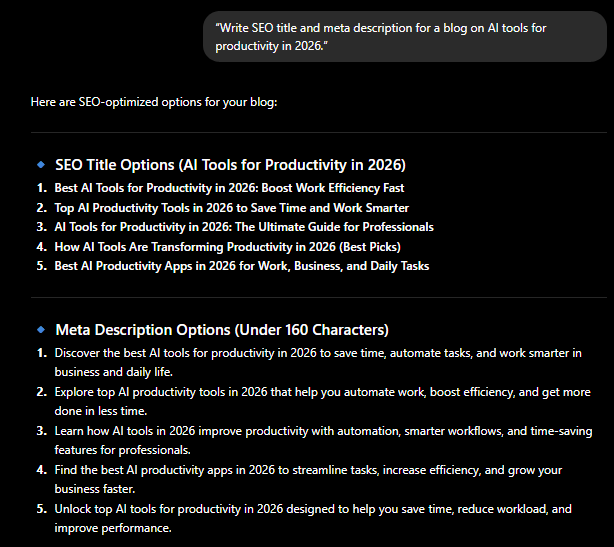
→ Optimized content ready for publishing.
Step 4: Repurposing Content
Prompt: “Summarize this blog into 3 tweet threads.”
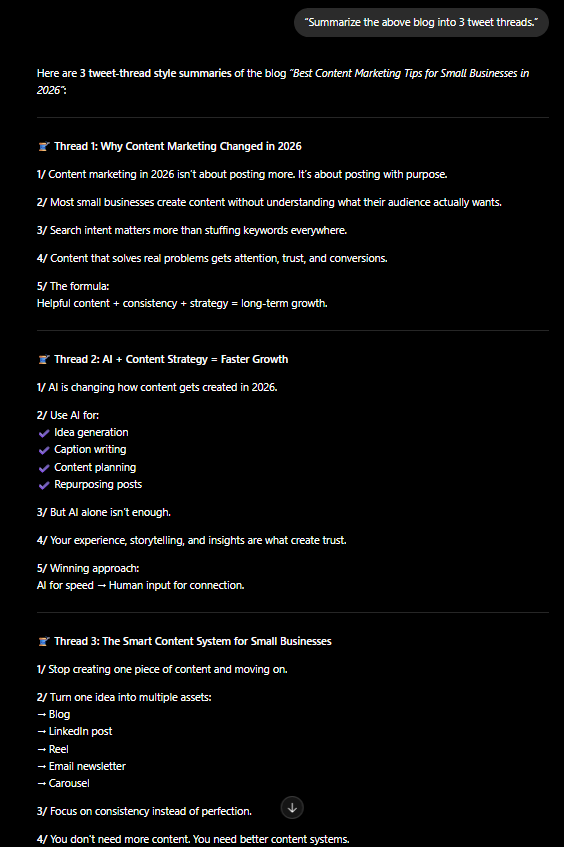
→ Now I have Twitter content for the week, too.
Step 5: Email Campaign
Prompt: “Write a welcome email for new subscribers joining my content strategy newsletter.”
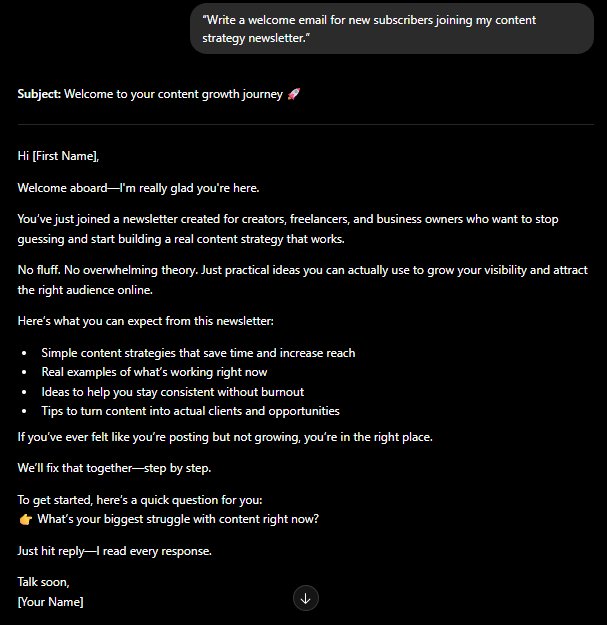
→ Engaging copy that fits my tone.
Step 6: Scheduling
I copy-paste the generated content into my scheduling tools like Notion, Metricool, or Buffer.
ChatGPT Use Cases for Marketing
Email Marketing
Prompt: “Write a follow-up email for webinar attendees. Include a CTA to download our free guide.”
Social Media Replies
Prompt: “Generate 5 friendly replies to comments like ‘Great post! How do I start with AI marketing?’”
Ad Copy Testing
Prompt: “Write 3 Facebook ad variations for a coaching program targeting entrepreneurs.”
Conclusion: Don’t Get Left Behind! Start Using AI for Marketing
AI won’t replace great marketers, it will replace those who don’t use it. You don’t need a huge team. You just need better tools and smarter systems.
Try this right now: Paste this into ChatGPT → “Create 10 content ideas for my [niche] brand.”
You’re one prompt away from less burnout, more growth, and a streamlined workflow.
Need help? Check out our free blog 5 Must Have AI Tools to Boost Productivity in 2026 to automate your workflow.
So, whether you’re a solo freelancer or a small business owner, it’s time to take the leap. Try ChatGPT. Experiment. Improve. And automate your way to more visibility, engagement, and growth.
FAQs
Can I use ChatGPT for Instagram content?
Yes! Just prompt it with your theme and tone, and it can create captions, stories, and carousel content.
Is ChatGPT free to use?
There is a free plan, but for marketing, GPT-5 (paid version) provides much better results.
Can ChatGPT write emails for me?
Absolutely. It can write full email sequences, newsletters, subject lines, and more.
Will AI content rank on Google?
Yes! If it’s helpful, original, and optimized. Google ranks quality, not authorship.
Does Google penalize AI content?
No. Google only penalizes spammy, low-value content, whether it’s human or AI-written.
Can I use ChatGPT to create a full content calendar?
Yes, just provide your niche, audience, and goals, it will suggest daily ideas.
How do I ensure my content doesn’t sound robotic?
Edit ChatGPT’s output to reflect your voice and add a human touch.
Is it okay to use ChatGPT for ad copy?
Yes, many marketers use it for writing Google Ads, Meta Ads, and more.
Does ChatGPT save time?
Huge time-saver! What used to take me 4-6 hours now takes less than 90 minutes.
Can I train ChatGPT to know my brand voice?
Yes. With consistent prompts and examples, it will start mirroring your tone.