
According to CB Insights, 90% of startups fail, and nearly 42% fail because they create products with no market need. If you’re a first-time founder stepping into entrepreneurship in 2026, these stats should raise red flags. But here’s the good news: failure isn’t inevitable. Most startup mistakes are avoidable if you know where the pitfalls lie.
In this guide, you’ll learn the top mistakes first-time founders make in 2026, and more importantly, how to prevent them. Whether you’re building a personal brand, launching a small business, or scaling an early-stage startup, this advice will help you sidestep costly errors and build for sustainable business growth.
Let’s break the curse that holds back most first-time founders and set your new venture on the right path.
Avoid These Startup Mistakes in 2026
Starting a business is one of the boldest things you can do, but also one of the riskiest. First-time founders often fall into predictable traps that cost time, money, and morale. The key is learning from the mistakes of those who’ve gone before you.
Below, we unpack the common startup mistakes to avoid as a new founder. For each, we’ll explain why it happens and how to avoid it with actionable steps.
1. Building Without Validating the Problem First
Why This Happens
First-time entrepreneurs often fall in love with their ideas. Excited by the novelty or technical brilliance of their solution, they skip the crucial step of confirming that real customers actually want what they’re building. It feels faster and more fun to create than to research, but this leads to products that flop at launch.
How to Avoid It
✔ Start with the customer, not the product. Before writing a single line of code or ordering inventory, talk to your target market. Use surveys, interviews, and landing pages to gauge interest.
✔ Test demand with small bets. Offer pre-orders, pilot programs, or crowdfunding campaigns. If no one signs up, it’s time to rethink.
✔ Adopt the MVP mindset. Focus on solving one real, validated problem for one clear customer segment and test it before scaling.
Many startup failures begin with building something nobody needs.
2. Ignoring the Importance of Go-to-Market Strategy
Why This Happens
Many first-time founders believe that “if you build it, they will come.” They invest heavily in product development but fail to plan how to acquire customers. In today’s noisy market, even the best product can fail without a solid go-to-market plan.
How to Avoid It
✔ Identify your ideal customer profile early. Who are they? Where do they hang out? What problems keep them up at night?
✔ Map your customer journey. How will people discover your product? What channels will you use, SEO, social media, ads, partnerships?
✔ Set clear marketing and sales goals. A go-to-market plan should cover pricing, distribution, messaging, and metrics for success.
Founders who skip this step often face poor traction, wasted resources, and missed product-market fit.
3. Weak Traction and Growth Metrics
Why This Happens
In the early excitement, first-time founders often focus on vanity metrics likes, downloads, or website hits, without measuring what truly matters. Investors and stakeholders want to see traction that signals scalable growth potential.
How to Avoid It
✔ Track meaningful metrics. Focus on customer acquisition cost (CAC), lifetime value (LTV), churn rate, conversion rates, and engagement levels that correlate with revenue.
✔ Set realistic growth targets. Break them down by month or quarter and align them with specific initiatives.
✔ Be transparent with stakeholders. Early-stage startups gain trust when they show consistent tracking and learning from the data.
In 2026, early-stage startup pitfalls often stem from poor data discipline. Make metrics your guide, not an afterthought.
4. Neglecting Legal and Financial Infrastructure
Why This Happens
For many founders, dealing with legal contracts, compliance, accounting, and intellectual property feels tedious. It’s easy to push these tasks aside while focusing on product development or sales. But the cost of ignoring them can be enormous from lawsuits to tax penalties.
How to Avoid It
✔ Incorporate and structure your business properly. Choose the right entity type (LLC, S-Corp, etc.) based on your goals.
✔ Protect your intellectual property. Register trademarks, patents, or copyrights as needed.
✔ Set up sound accounting practices from day one. Use tools or hire a professional to handle bookkeeping, taxes, and compliance.
✔ Draft clear contracts. Whether working with freelancers, partners, or vendors, proper contracts protect your business.
Many founder lessons are learned the hard way in courtrooms or tax offices. Don’t let that be you.
5. Poor Team Building
Why This Happens
Hiring friends, family, or the cheapest talent available may feel like the easiest path. But without the right skills and culture fit, teams can fracture under pressure, creating one of the most common small business challenges.
How to Avoid It
✔ Prioritize skills over convenience. Even in early days, hire or partner with people who compliment your strengths and share your vision.
✔ Cultivate culture intentionally. Define values and communicate them clearly. Build a team that believes in your mission.
✔ Give people room to grow. Invest in mentorship, learning, and clear career paths even in a startup’s scrappy early days.
Your team is your biggest asset or your biggest liability. Choose wisely.
6. Waiting Too Long to Launch
Why This Happens
Perfectionism is a sneaky startup killer. Founders want the product, website, or brand to be flawless before showing it to the world. But this delay costs opportunities, feedback, and momentum.
How to Avoid It
✔ Launch a minimum viable product (MVP) quickly. Let real users show you what needs fixing.
✔ Iterate based on feedback. Use data and customer input to improve, rather than guessing in a vacuum.
✔ Embrace imperfection. Remember: no product is perfect at launch. Early adopters often appreciate being part of your growth journey.
Delaying feedback is a costly startup misstep that costs new founders time and money.
7. Avoiding Feedback and Mentorship
Why This Happens
Some first-time founders feel they should have all the answers. Others fear criticism or think asking for help shows weakness. But this mindset limits your learning curve and increases the risk of preventable failure.
How to Avoid It
✔ Find mentors. Join entrepreneur groups, incubators, or online communities.
✔ Build an advisory board. Surround yourself with people who’ve done what you’re trying to do.
✔ Actively seek customer feedback. Don’t just wait for reviews. Ask, listen, and adjust.
Success often comes from founders who embrace feedback early
Bonus: Don’t Ignore Cash Flow in Your Startup
Don’t underestimate cash flow management.
You can have a popular product and still run out of money if you mismanage cash flow. Set budgets, track spending, and plan for slow sales periods.
Free Checklist: 10 Mistakes to Avoid as a First-Time Founder
✅ Building without validating
✅ No go-to-market plan
✅ Weak growth metrics
✅ Ignoring legal setup
✅ Poor hiring
✅ Delayed launch
✅ No mentorship
✅ Weak cash flow planning
✅ Overlooking competition
✅ Neglecting customer support
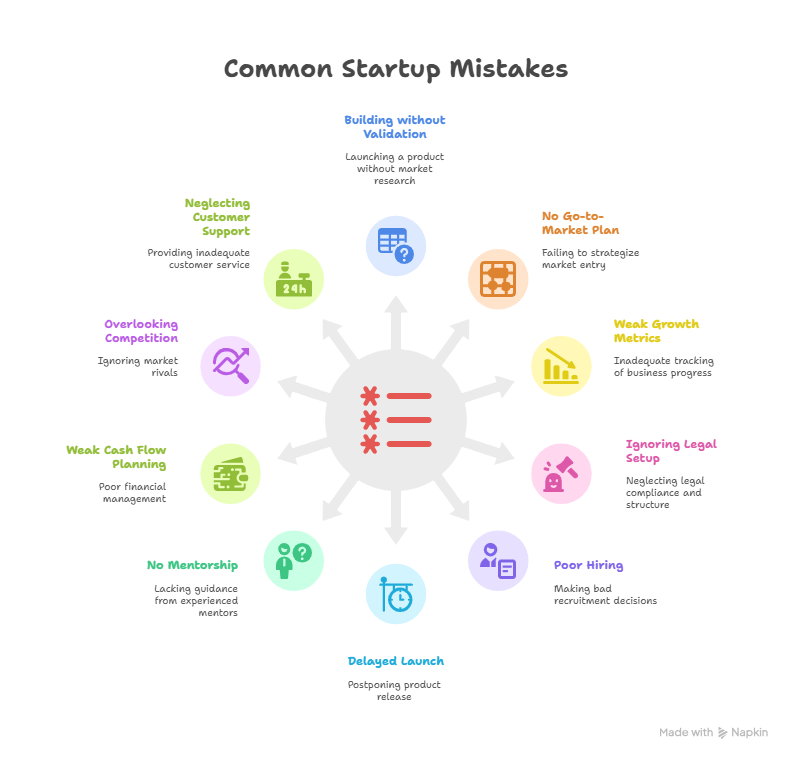
Print this, stick it to your desk, and review often.
Final Words: Ready to Avoid These Mistakes?
The path to startup success isn’t about being perfect, it’s about being prepared. Now that you know the top mistakes first-time founders make, it’s time to act. Don’t let your dream die from avoidable missteps.
Start validating your idea. Map out your go-to-market plan. Build the right team. Seek feedback. Launch. Iterate. Grow.
Time is your most valuable resource, and every day counts. Your future business success starts with the steps you take today. Are you ready to build smarter, stronger, and faster? The choice is yours.
FAQs
What are the top mistakes first-time founders make in 2026?
The most common mistakes include building without validation, lacking a go-to-market plan, poor traction metrics, neglecting legal setup, bad team hires, delayed launches, and avoiding feedback.
How can new founders prevent failure?
By validating ideas early, building strong teams, tracking meaningful growth metrics, launching fast, and seeking guidance.
Why is a go-to-market strategy critical for first-time founders?
Without it, even great products fail because customers don’t discover or understand their value.
How do I validate my startup idea?
By talking to target customers, testing MVPs, and seeing if people will pay for or commit to your solution.
When should I launch my startup?
As soon as you have an MVP that solves a validated problem. Don’t wait for perfection.
What legal steps should I take early?
Incorporate your business, protect IP, set up contracts, and establish proper accounting.
How can I find a mentor as a new founder?
Join startup networks, incubators, or communities like Founder Institute or Indie Hackers.
Why do startups fail despite having a great product?
Without market need, clear growth strategies, and strong execution, even great products struggle.